In 2012, Blackstone entered US single-family residential at 8%+ cap rates. By the Invitation Homes IPO in 2017, the portfolio was valued at $5.9 billion. The strategy was not novel. The execution was.
Five years before the IPO, US single-family rental (SFR) was widely considered uninvestable for institutional capital. The sector was 99% owned by retail landlords. Each property required individual acquisition, financing, renovation, and tenanting. Yields looked attractive on paper but the operational drag from sub-scale management was assumed to consume the spread. Sophisticated investors avoided it.
Blackstone's thesis was specific and operational: the sector wasn't uninvestable, it was uninstitutionalised. If a single operator could acquire 50,000+ houses at scale, build a standardised operating platform, and consolidate the fragmented retail base, the resulting business would not trade as a basket of houses. It would trade as an operating company.
The playbook had six distinct phases.
Phase 1: Identify the spread
Blackstone's opening insight was that the institutional consensus had mispriced operational complexity. SFR yields were 200–400bps above multifamily despite comparable underlying tenant demand, lower turnover, and demographic tailwinds. The yield premium was compensation for operational difficulty, not credit risk. If the operational problem could be solved at scale, the spread was a free option.
Phase 2: Build the operating platform first, not the portfolio
The most counter-intuitive decision Blackstone made was to spend the first six months building Invitation Homes' operating capability — centralised maintenance, standardised tenancy contracts, in-house property management, technology-driven rent collection and inspections — before scaling acquisitions. Competitors raced to acquire; Blackstone built the chassis. The result was operating margins 200–400bps above the fragmented retail base from day one.
Phase 3: Acquire in concentrated markets
Rather than spreading acquisitions nationally, Invitation Homes concentrated on a handful of metropolitan markets with favourable demographics, supply constraints, and economic momentum — Atlanta, Phoenix, Tampa, Dallas. Geographic concentration produced operational density: a maintenance crew could cover multiple properties in a single shift, reducing per-property operating cost dramatically. Density was not incidental to the thesis. It was the thesis.
Phase 4: Lever conservatively, distribute consistently
Blackstone deliberately under-levered the portfolio relative to what was available, financing acquisitions at conservative loan-to-cost ratios. The objective was not to optimise IRR on entry. The objective was to produce a portfolio that read as institutional-grade to public-market investors at exit. Distribution coverage, debt service coverage, and leverage discipline were managed to public REIT standards from launch.
Phase 5: Demonstrate two years of operating data
Before approaching the public markets, Invitation Homes operated at scale for 2.5 years to produce a credible track record on three metrics: portfolio occupancy, rental growth, and operating margin. These three numbers, presented over multiple quarters, were the basis on which equity research would value the eventual REIT. Without them, the IPO would have been a leveraged buyout exit at private-market multiples.
Phase 6: Exit to the public market
Invitation Homes IPO'd on the NYSE in January 2017 at a $5.9B equity value, returning multiples of invested capital to Blackstone's funds. By the time it merged with Starwood Waypoint Homes later that year, the combined entity owned 82,000 homes and traded at a public-market premium to underlying NAV. The exit valuation was a multiple of where the basket of houses would have traded individually.
Where the UK HMO analogue is exact
The UK HMO sector in 2026 has the same shape as US SFR in 2012:
- A 300–400bps yield premium to the institutional residential consensus (BTR, PRS).
- 99%+ retail/sub-scale ownership of the existing stock.
- No listed UK REIT or large private operator above 5,000 rooms.
- Specialist debt available at conventional spreads for the first time.
- Institutional demand for income-producing residential at scale — pension funds and insurance balance sheets need long-duration UK residential allocations.
- A regulatory environment that is forcing the marginal landlord out, freeing up acquisition pipeline at distressed pricing.
Where it differs — and where that helps
UK HMO has three advantages over the 2012 US SFR situation that argue for a faster institutionalisation cycle.
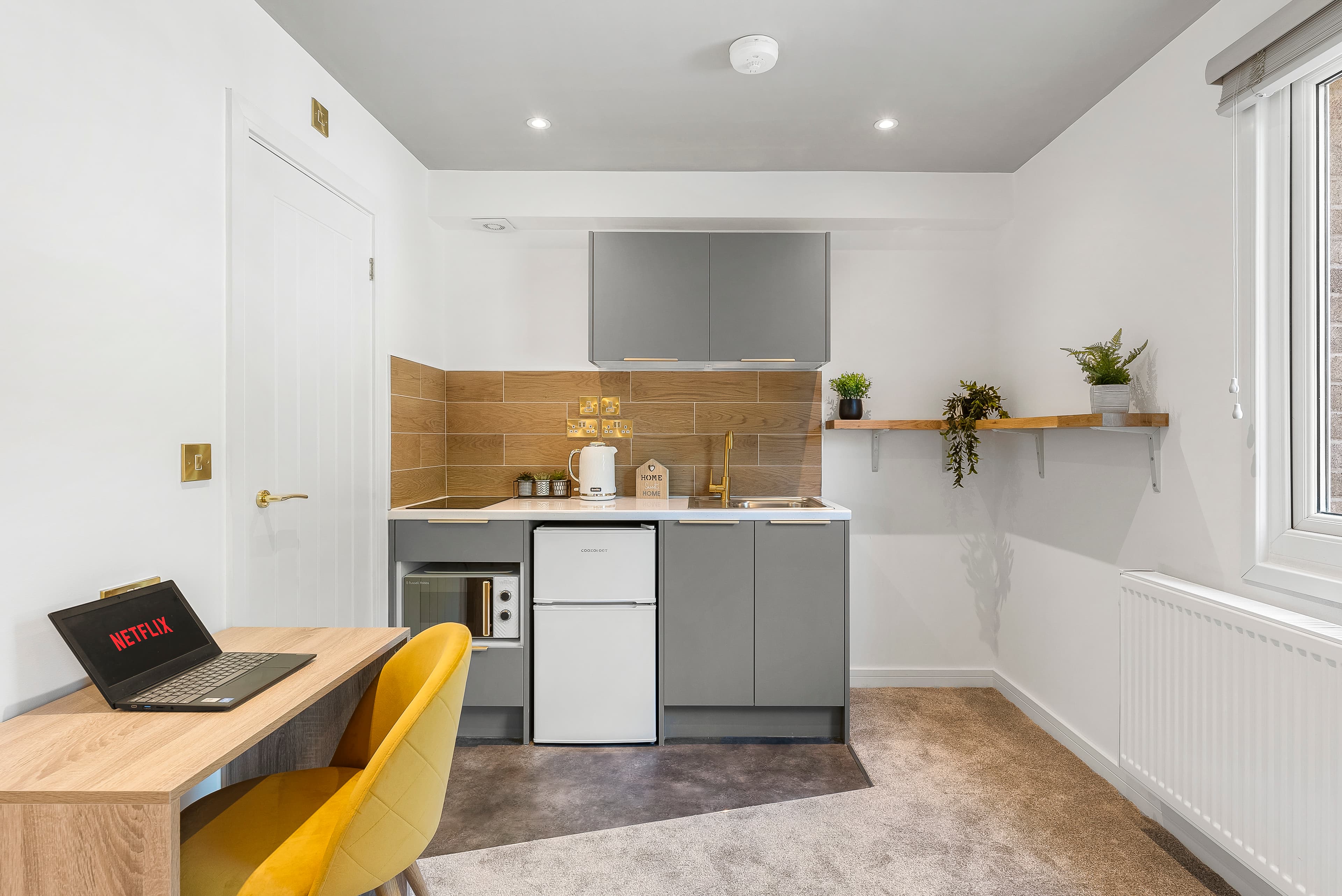
Higher operating density per property. A six-bedroom HMO produces six income streams from a single property. Operating density is structurally higher than SFR. The operating margin headroom for an institutional operator is correspondingly higher.
Stronger regulatory supply constraint. Article 4 Directions and Mandatory Licensing schemes have effectively frozen new HMO supply in over 50 UK councils. US SFR had no equivalent structural supply moat. The implication: institutional acquisition pressure does not generate competitive new construction.
A clearer exit path. The UK listed REIT market is well-established for sector-specific operating REITs (USAR, Triple Point Social Housing, Civitas Social Housing, Target Healthcare). The institutional buyer at exit — a sector-specific HMO REIT — is a clearly visible counterparty, not a speculative one.
The playbook is known. The capital infrastructure is in place. The remaining variable is execution.
Comparisons to Blackstone/Invitation Homes are illustrative of the strategy archetype only and do not imply equivalent outcomes. Capital is at risk; past performance of unrelated strategies is not a guide to future returns of R&P offerings. Return figures, capital structure, and exit assumptions for the current offering are disclosed in the data room available to certified investors.